Last Updated: April 27, 2026
Is White Chocolate Vegan
Traditional white chocolate isn’t vegan—you’ll find it contains at least 14% milk solids and 3.5% milk fat according to FDA regulations, alongside its 20% minimum cocoa butter content. These dairy components provide essential emulsification properties and contribute to the characteristic creamy texture. However, vegan alternatives have emerged using plant-based substitutes like rice milk powder and oat milk to replicate the sensory profile. Brands like Pascha and No Whey! Foods now offer formulations that achieve comparable melting points and textures, though ingredient labels require careful examination to verify dairy-free certification.
Contents
show
Is White Chocolate Vegan? The Short Answer
Why does milk matter in white chocolate classification?
Traditional white chocolate isn’t vegan—the FDA mandates that white chocolate contain at least 14% milk solids and 3.5% milk fat alongside the required 20% cocoa butter.
These dairy components create the characteristic creamy texture you’re familiar with.
However, vegan white chocolate alternatives now exist using plant-based formulations.
Manufacturers substitute milk derivatives with dairy alternatives like coconut milk powder, rice milk, or other plant-based ingredients while maintaining the required cocoa butter content.
You’ll find these products certified as dairy-free and suitable for those with ethical considerations regarding animal products.
To guarantee you’re purchasing genuinely vegan white chocolate, verify ingredient labels for dairy-free certifications, as standard formulations invariably contain animal-derived components that disqualify them from vegan classification.
What’s Actually in Traditional White Chocolate
Traditional white chocolate consists of three core ingredients: cocoa butter (minimum 20%), milk solids (at least 14%), and sugar, with milk fat content required to meet or exceed 3.5% per FDA standards.
These compositional requirements distinguish genuine white chocolate from confectionery coatings that substitute vegetable fats for cocoa butter.
The absence of cocoa solids—the component containing chocolate liquor—explains white chocolate’s pale ivory color and fundamentally different nutritional profile compared to dark or milk chocolate varieties.
Core Ingredients Breakdown
White chocolate’s formulation centers on three essential components: cocoa butter (20-40% by weight), milk solids (minimum 14% as mandated by FDA standards), and sugar (typically 45-55%).
The cocoa butter delivers the characteristic melt-in-your-mouth texture while remaining completely devoid of cocoa solids—the flavonoid-rich compounds that define dark chocolate.
Milk powder contributes both structural integrity and dairy proteins, creating an immediate barrier for vegan consumption.
Flavor improvement techniques typically incorporate vanilla extract or vanillin to mask cocoa butter’s subtle taste.
You’ll notice some manufacturers use cocoa butter alternatives like palm kernel oil or hydrogenated vegetable fats, though these substitutions disqualify products from legitimate white chocolate classification under FDA regulations.
This compositional reality means you’re consuming primarily saturated fats and refined sugars with animal-derived proteins—fundamentally incompatible with plant-based dietary requirements.
Legal Definition Requirements
Regulatory bodies worldwide impose strict compositional thresholds that determine whether a product can legally bear the “white chocolate” designation.
Both FDA and EU regulations mandate minimum requirements: 3.5% milk fat, 14% milk solids, and 26% cocoa butter.
You’ll notice these standards carry significant legal implications for manufacturers who mislabel products using vegetable fats instead of cocoa butter.
This distinction matters because cocoa butter absence fundamentally changes the product’s classification from chocolate to confection.
Consumer awareness becomes critical when evaluating authenticity, as non-compliant products can’t legally claim white chocolate status despite similar appearance.
The regulatory framework exists specifically to prevent deceptive labeling practices that exploit your expectations.
Understanding these compositional requirements helps you identify genuine white chocolate versus imitation alternatives in marketplace selections.
Why Most White Chocolate Contains Dairy
White chocolate’s dairy content stems from FDA regulations mandating minimum thresholds of 3.5% milk fat and 14% milk solids for legal classification as “white chocolate.”
These milk-derived components—typically sourced from cow’s milk powder—provide essential emulsification properties that bind cocoa butter with sugar, creating the product’s smooth, stable consistency.
The milk proteins and lactose contribute specific flavor compounds and structural integrity that plant-based substitutes can’t replicate while maintaining the regulatory definition.
FDA Milk Requirements Explained
According to FDA regulations codified in 21 CFR 163.124, manufacturers must incorporate at least 3.5% milkfat and 14% total milk solids into any product bearing the “white chocolate” designation.
These compositional thresholds establish dairy as a mandatory component, effectively excluding vegan formulations from official classification. The milk fat contributes essential emulsification properties, while milk solids provide the characteristic flavor profile and texture.
Key compositional requirements include:
- Minimum 3.5% milk fat derived exclusively from dairy sources
- 14% total milk solids containing lactose and milk proteins
- 20% cocoa butter content as the primary fat component
- Complete exclusion of dairy alternatives like coconut, almond, or oat-based ingredients
Products using dairy alternatives can’t legally carry the “white chocolate” label, relegating vegan versions to alternative nomenclature such as “white confection” or “white baking wafers.”
Traditional White Chocolate Ingredients
Beyond regulatory mandates, the dairy components in traditional white chocolate serve critical functional roles that determine the product’s sensory characteristics and structural integrity.
You’ll find milk powder contributing essential proteins and lactose that create the characteristic creamy mouthfeel and sweet flavor profile that’s defined white chocolate history since its inception. The milk fat content (minimum 3.5%) works synergistically with cocoa butter’s crystalline structure to achieve ideal texture and melting properties.
These dairy-derived ingredients constitute approximately 14% minimum milk solids, which you can’t replicate with simple substitutions.
However, modern food science has enabled vegan chocolate alternatives that use plant-based milk powders from coconut, rice, or oat sources, combined with emulsifiers like sunflower lecithin, to approximate traditional white chocolate’s compositional framework without animal-derived ingredients.
Dairy’s Role in Texture
When cocoa butter crystallizes into its stable polymorphic form during tempering, dairy proteins and lactose create an interfacial network that modulates the crystallization kinetics and prevents excessive fat bloom.
Dairy components fundamentally determine white chocolate’s structural properties:
- Milk fat globules (3.5% minimum) contribute short-chain fatty acids that lower the melting point, creating smooth oral dissolution.
- Casein micelles from milk solids (14% minimum) stabilize the fat-sugar matrix through electrostatic interactions.
- Lactose crystals provide textural roughness control while improving sweetness perception through molecular binding.
- Whey proteins undergo Maillard reactions during processing, developing characteristic caramelized notes absent in cocoa-free formulations.
Plant based innovations now employ protein isolates and modified starches as texture alternatives, though replicating dairy’s multifunctional matrix requires sophisticated compositional analysis and precise ingredient ratios.
What Goes Into Vegan White Chocolate Instead
Vegan white chocolate manufacturers replace dairy-derived milk solids with plant-based alternatives that maintain the confection’s characteristic creamy texture and sweet flavor profile. You’ll find rice milk powder and oat milk serving as primary substitutes, providing essential creaminess without animal products.
Cacao butter remains the foundational fat source, delivering the signature mouthfeel you expect. Non-dairy emulsifiers, particularly soy or sunflower lecithin, guarantee proper ingredient binding and smooth consistency.
These vegan alternatives use sweeteners like organic raw cane sugar or coconut sugar, selected through ethical sourcing practices that avoid bone char filtration processes.
Vanilla extract amplifies flavor complexity, creating an indulgent experience comparable to conventional formulations. The compositional analysis reveals that plant-based ingredients successfully replicate traditional white chocolate’s sensory characteristics while adhering to strict vegan standards.
How Vegan White Chocolate Tastes Compared to Dairy Versions
The sensory profile of plant-based white chocolate closely mirrors its dairy counterpart through strategic ingredient formulation. However, compositional differences produce measurable variations in taste perception and textural properties.
Taste comparisons reveal that cocoa butter combined with rice or oat milk derivatives generates comparable sweetness and creaminess. However, flavor profiles demonstrate brand-specific variations based on plant-based ingredient selection.
Key sensory distinctions you’ll encounter:
- Mouthfeel characteristics: Vegan versions exhibit reduced richness due to milk solid absence, compensated through lecithin emulsification.
- Textural properties: Plant-based stabilizers create structural integrity comparable to dairy formulations.
- Flavor complexity: Ingredient variability produces broader taste spectrum across brands.
- Quality correlation: Premium vegan options achieve near-equivalence in taste comparisons, validating viability for dietary restriction compliance.
Consumer perception studies confirm high-quality formulations deliver satisfactory dairy alternatives.
Top Vegan White Chocolate Brands: Pascha, No Whey, and Whitakers
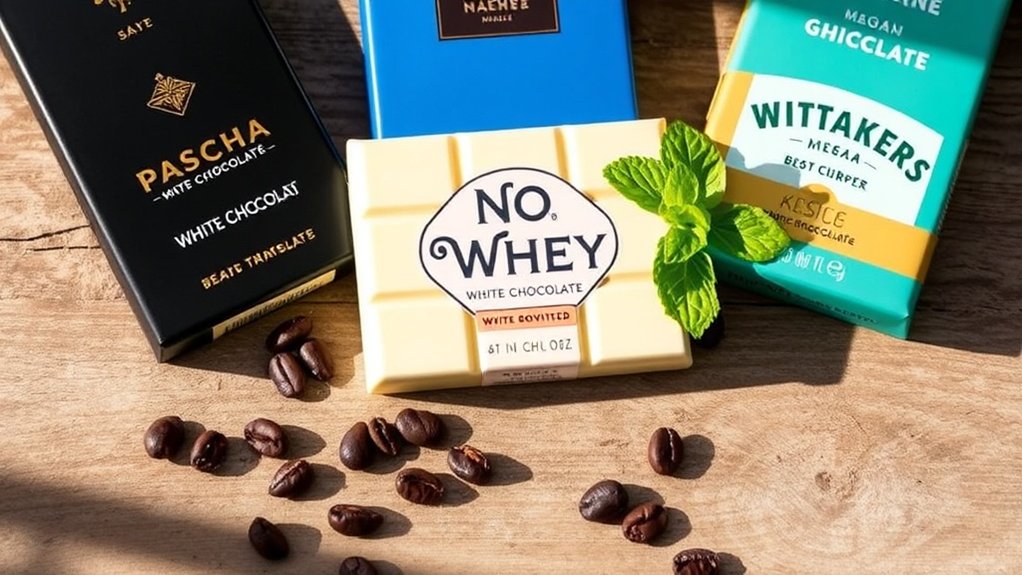
When selecting vegan white chocolate, you’ll find Pascha’s Organic White Bar contains rice milk powder and vanilla extract as primary substitutes for dairy components, with cocoa butter sourced from Peruvian beans providing the characteristic fatty acid profile.
No Whey! Foods formulates its products using plant-based milk alternatives while maintaining allergen-free manufacturing protocols, eliminating the top eight allergens including dairy proteins.
These brands achieve comparable melting points and texture profiles to conventional white chocolate through precise ratios of cocoa butter, plant-based milk solids, and emulsifiers.
Pascha’s Organic White Bar
Among ethically-sourced vegan white chocolate options, Pascha’s Organic White Bar demonstrates rigorous adherence to both FDA compositional standards and plant-based formulation requirements.
You’ll find this certified organic bar contains >20% cocoa butter, achieving regulatory white chocolate classification without dairy derivatives. The formulation substitutes rice milk for conventional milk solids, maintaining creamy texture while preserving complete vegan integrity.
Key compositional characteristics include:
- Peruvian cacao sourced through sustainable farming partnerships
- Rice milk-vanilla base providing dairy-alternative functionality
- Gluten-free, allergen-friendly formulation for dietary restriction compatibility
- Complete transparency through organic certification and plant-based verification
Pascha benefits extend beyond compositional compliance—ethical sourcing practices guarantee supply chain accountability from Peruvian farms through final production.
This commitment positions the brand as a scientifically-sound option for plant-based consumers requiring verified ingredient integrity.
No Whey Allergen-Friendly Treats
How effectively can allergen-sensitive consumers access vegan white chocolate without compromising safety or taste preferences? No Whey Foods addresses this critical need through specialized manufacturing protocols that eliminate common allergens.
Their product line features allergen friendly formulations free from dairy, nuts, gluten, and soy—ingredients that typically trigger adverse reactions in sensitive individuals. The brand’s compositional framework substitutes traditional milk solids with plant-based alternatives while maintaining the characteristic fatty acid profile that creates white chocolate’s smooth texture.
You’ll find their products certified through rigorous testing standards, making sure cross-contamination prevention during production. This technical approach allows you to consume vegan white chocolate with confidence, knowing that both ethical sourcing and allergen safety protocols meet clinical requirements for those managing multiple food sensitivities.
Where to Buy Vegan White Chocolate Online and In Stores
Finding vegan white chocolate requires identifying retailers that stock products formulated without milk solids, whey powder, or other dairy derivatives. You’ll locate certified options through multiple distribution channels, each offering distinct advantages for ingredient verification.
Strategic purchasing locations include:
- Online shopping platforms like Amazon and manufacturer websites provide thorough product specifications, certification documentation, and flavor variety across brands like Pascha Chocolate and No Whey! Foods.
- Specialty chocolate shops offer curated selections with staff expertise in compositional differences between conventional and plant-based formulations.
- Health food stores maintain dedicated vegan sections featuring white chocolate bars and confections that meet strict plant-based standards.
- Direct manufacturer channels confirm authenticity through traceable supply chains and detailed allergen information.
Examine packaging for plant-based certifications verifying the absence of animal-derived ingredients, confirming compliance with vegan dietary requirements.
Baking and Cooking With Vegan White Chocolate

Once you’ve sourced quality vegan white chocolate products, their functional properties enable direct substitution in conventional recipes requiring dairy-based formulations. You’ll achieve ideal chocolate textures in vegan baking by selecting products containing a minimum 20% cocoa butter content, confirming proper melting characteristics for ganaches, mousses, and truffles.
The cocoa butter component provides similar crystallization patterns to dairy-based alternatives, maintaining structural integrity across temperature variations.
High-quality formulations melt and emulsify comparably to traditional white chocolate, facilitating smooth integration into cookies, cakes, and brownies. You can manipulate these products through gel coloring additions for festive applications or incorporate them into flavored variations.
The creamy sweetness profile remains consistent without dairy constituents, while proper cocoa butter ratios preserve the desired mouthfeel and working properties essential for professional-quality results.
Whey, Casein, and Lactose: Spotting Hidden Dairy on Labels
Scrutinizing ingredient lists requires understanding that dairy derivatives appear under multiple technical nomenclatures that obscure their origin.
When evaluating white chocolate for vegan suitability, you’ll encounter these problematic compounds:
- Whey and whey protein isolate function as cheese production byproducts that manufacturers incorporate into chocolate formulations.
- Casein and caseinate derivatives serve as milk-derived emulsifiers that bind chocolate components together.
- Lactose represents milk sugar that may appear without explicit dairy warnings on ingredient labeling.
- Sodium caseinate and calcium caseinate indicate dairy protein presence despite their chemical-sounding names.
Evidence-based compositional analysis demands you verify certifications explicitly stating “dairy-free” or “vegan” rather than relying solely on absent milk terminology.
Manufacturers of dairy alternatives increasingly provide transparent ingredient labeling, yet regulatory standards don’t mandate highlighting trace dairy components.
Does Cocoa Butter Make White Chocolate Vegan?
While cocoa butter itself represents a fully plant-derived fat extracted from cacao beans, its presence doesn’t automatically confer vegan status to white chocolate products.
Traditional formulations require 3.5% milk fat and 14% milk solids alongside the FDA-mandated 20% cocoa butter minimum, negating any cocoa butter benefits for vegans.
You’ll find that vegan chocolate comparisons reveal a critical distinction: cocoa butter remains plant-based, but accompanying ingredients determine final classification.
Vegan alternatives substitute dairy components with plant-based milk solids while maintaining cocoa butter’s smooth texture and neutral flavor profile.
When evaluating products, you must examine complete ingredient lists rather than assuming cocoa butter content alone guarantees vegan compliance.
Ethical sourcing of cocoa butter from plant-based producers supports vegan principles, yet overall product formulation remains the decisive factor.
This article was reviewed by Nicole Anderson, RDN.