Last Updated: March 28, 2026
Are Olives a Veg
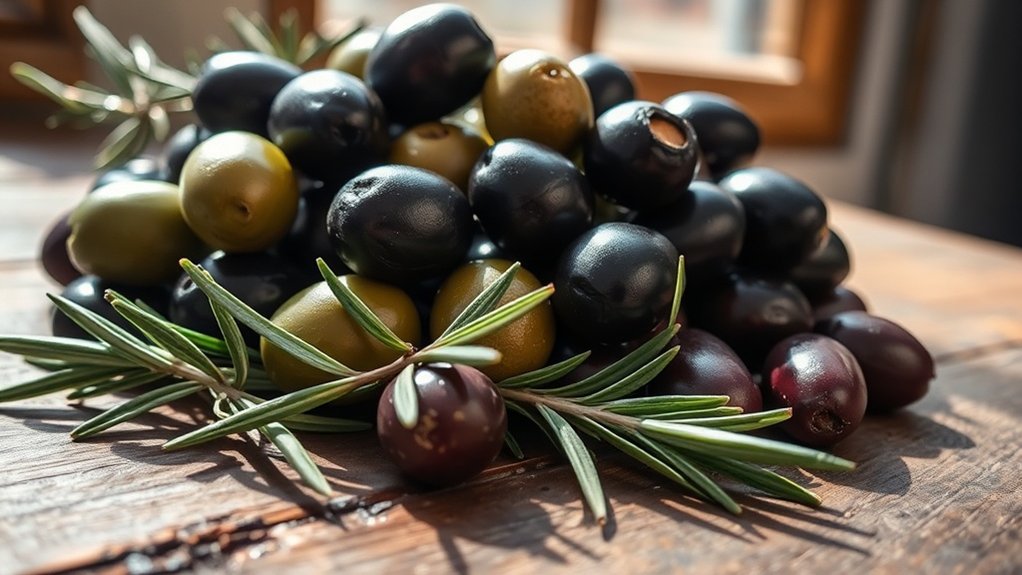
Olives aren’t vegetables—they’re fruits, specifically drupes from *Olea europaea*. You’re seeing a stone fruit with the same botanical structure as peaches and cherries: an outer skin (exocarp), fleshy middle layer (mesocarp), and hard pit containing the seed (endocarp). Their savory taste stems from high lipid content (15-30%) and minimal sugars (less than 3%), plus bitter oleuropein compounds that require curing before consumption. Understanding how these unique characteristics separate olives from typical fruits reveals why they’ve earned their distinctive culinary role.
Contents
show
Are Olives a Fruit or a Vegetable?
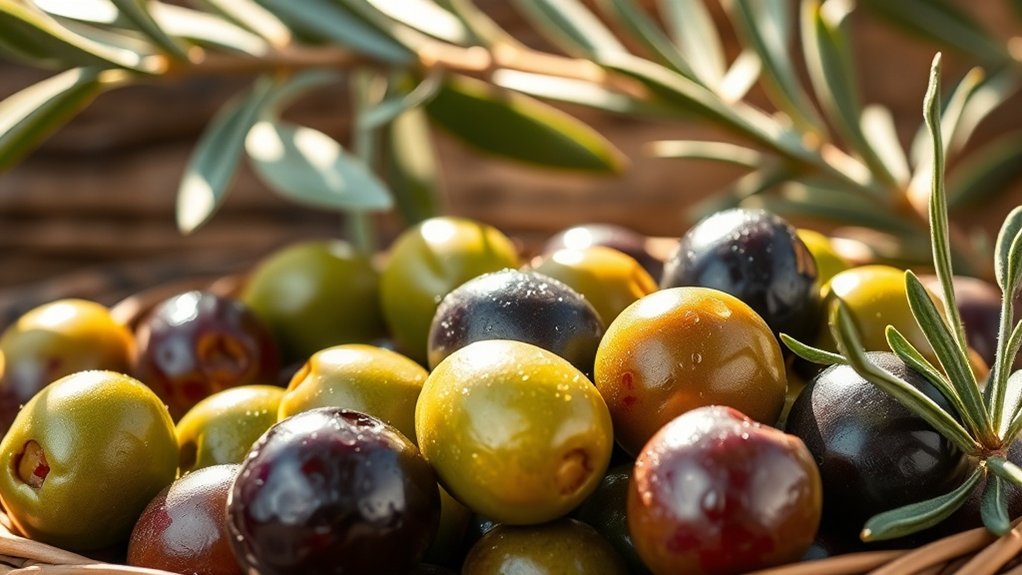
Botanically speaking, olives qualify as fruits because they develop from the ovary of the olive tree’s flower (*Olea europaea*) and contain seeds within their structure. More precisely, they’re drupes—fruits characterized by a fleshy outer layer surrounding a hard stone that encases a single seed. This classification definitively answers whether olives are fruit or veg from a scientific standpoint.
However, you’ll notice that culinary practice often contradicts botanical taxonomy. Olives’ savory flavor profile and their typical use in Mediterranean dishes lead many to perceive them as vegetables. This confusion stems from the disconnect between botanical classification and culinary convention.
Additionally, raw olives contain tannins that make them unpalatably bitter. They require processing methods like brining before consumption, which further distinguishes them from sweet, ready-to-eat fruits you’re accustomed to.
Why Olives Taste Savory Instead of Sweet
You’ll find that olives’ savory flavor profile stems from three distinct biochemical characteristics that distinguish them from typical sweet fruits.
Unlike most drupes, olives contain minimal fructose and glucose (typically less than 3% of fresh weight), while simultaneously possessing high concentrations of oleuropein—a secoiridoid compound that imparts pronounced bitterness.
Additionally, olives’ lipid content ranges from 12-30% depending on cultivar and ripeness, contributing oleic acid and other fatty acids that improve their characteristic umami and savory notes rather than sweetness.
Low Natural Sugar Content
The stark difference between olives and typical fruits lies in their carbohydrate composition: while most drupes contain 10-15 grams of sugar per 100 grams, olives contain merely 0.5 grams, representing a 95% reduction in natural sugars.
This minimal glucose and fructose content directly determines your taste perception, as sweetness receptors require sufficient sugar molecules to activate. You’ll notice olives lack the characteristic sweetness of peaches, plums, or cherries—fellow drupes with conventional sugar profiles.
Instead, their flavor matrix comprises mainly fatty acids, particularly oleic acid at 55-83% of total lipid content, which your palate interprets as savory rather than sweet.
This biochemical composition shifts olives from the sweet fruit category into umami-rich territory, fundamentally altering your sensory experience despite their botanical classification.
Bitter Compounds in Olives
When you bite into a raw olive, oleuropein—a secoiridoid glucoside compound constituting 1-3% of fresh fruit mass—immediately activates TAS2R bitter taste receptors on your tongue, producing an intensely acerbic sensation that can persist for hours.
This phenolic compound serves as the fruit’s primary defense mechanism against herbivory. Additional polyphenols and tannins compound the bitterness, creating a chemical profile incompatible with direct consumption.
Traditional curing methods—brining, lye treatment, or water-curing—hydrolyze oleuropein into non-bitter derivatives, primarily hydroxytyrosol and elenolic acid. This enzymatic breakdown requires weeks to months, depending on methodology.
The residual phenolic compounds post-curing contribute to olives’ characteristic savory flavor profile rather than sweetness, explaining their culinary classification as vegetables despite their botanical status as drupes.
High Fat Concentration
Unlike conventional fruits where sugars dominate the biochemical profile, olives accumulate 15-30% lipid content by fresh weight—primarily oleic acid (C18:1), a monounsaturated omega-9 fatty acid comprising 55-83% of total fat composition.
This lipid dominance fundamentally alters your taste perception. Fat molecules coat your tongue’s gustatory receptors, effectively masking residual fructose and glucose present in the drupe’s mesocarp tissue. You’ll experience umami-rich, savory notes rather than sweetness because oleic acid triggers specific taste pathways associated with satiety and richness.
Cultivars like Picual demonstrate this phenomenon distinctly, containing 20-27% oil that produces pronounced savory characteristics.
The fermentation process during brining further amplifies these lipid-derived flavors while enzymatically breaking down oleuropein—the bitter glucoside compound—making the high-fat profile’s savory qualities even more pronounced in your culinary experience.
Why You Can’t Eat Olives Fresh Off the Tree
You can’t consume olives directly from the tree because they contain oleuropein, a secoiridoid glucoside that produces an intensely bitter taste rendering them inedible.
This bitterness results from high concentrations of polyphenolic compounds and tannins that naturally protect the fruit from herbivores and pathogens.
Traditional brining processes hydrolyze and leach these bitter compounds through osmotic action, transforming the fruit into a palatable food product.
Extreme Bitterness From Polyphenols
Although olives (*Olea europaea*) appear ripe and inviting on the tree, their flesh contains oleuropein concentrations ranging from 1-3% by weight—a secoiridoid glucoside that renders them profoundly bitter and nearly inedible in their raw state.
This polyphenolic compound, alongside tannins, functions as a chemical defense mechanism against herbivorous predators while facilitating controlled fruit maturation.
You’ll experience immediate oral discomfort if you bite into an uncured olive: the high polyphenol content triggers intense bitterness, often accompanied by tongue tingling or transient numbness.
Traditional curing methods—including water-soaking, brining, or lye treatment—hydrolyze and leach these compounds over weeks or months, reducing oleuropein levels to palatable thresholds below 0.1%.
Without this deliberate processing intervention, olives remain biochemically protected and gastronomically unacceptable.
Brining Removes Natural Compounds
Brining uses osmotic principles to systematically extract oleuropein and related polyphenols from olive drupes through repeated salt-water submersion cycles.
You’ll find that sodium chloride concentrations typically ranging from 8-12% create a hypertonic environment, drawing bitter compounds outward while simultaneously inhibiting microbial growth. This process doesn’t merely mask unpalatable flavors—it fundamentally alters the fruit’s chemical composition through diffusion.
The duration varies by cultivar and processing method, requiring anywhere from weeks to months for complete debittering.
You’re basically reversing the olive’s natural defense mechanism against herbivory. Without this curing intervention, consumption triggers immediate oral discomfort: the polyphenolic compounds bind to oral mucosa proteins, causing astringency and temporary paresthesia.
Additionally, uncured drupes may induce gastrointestinal distress due to concentrated phenolic content that your digestive system can’t efficiently process.
How Curing Transforms Bitter Olives Into Edible Snacks
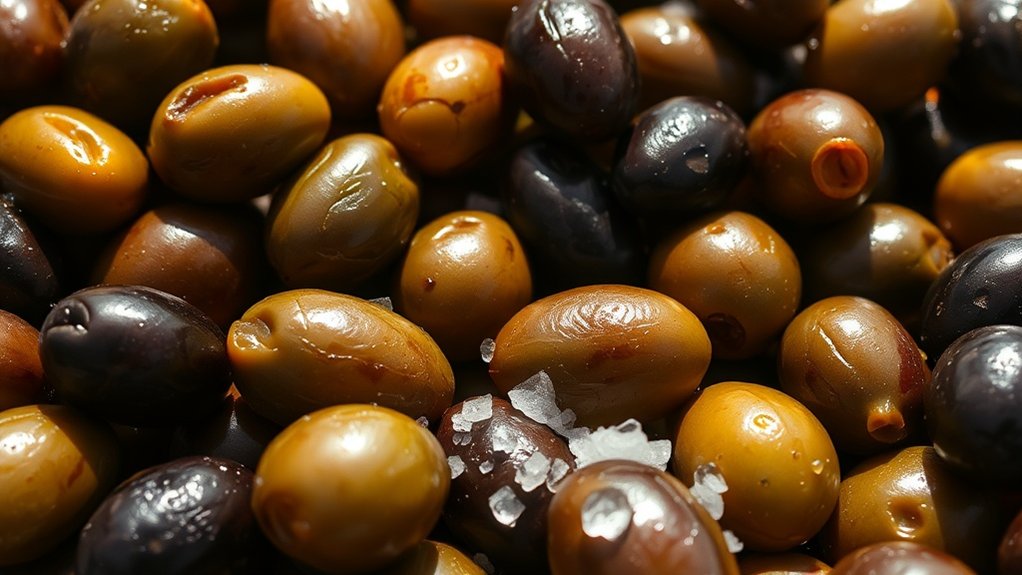
Three primary debittering methods transform raw drupes:
- Brine curing: Sodium chloride solutions (6-10% concentration) facilitate oleuropein leaching through osmotic diffusion over 3-12 months.
- Lye treatment: Alkaline sodium hydroxide solutions (2-3%) rapidly hydrolyze bitter glycosides within 8-12 hours.
- Dry salt curing: Crystalline sodium chloride draws moisture and phenolic compounds through osmosis, producing wrinkled, concentrated fruits.
These biochemical processes don’t just reduce bitterness—they develop characteristic organoleptic properties through enzymatic activity and microbial fermentation, creating the savory profiles you recognize.
Are Green and Black Olives Different Fruits?
Contrary to common misconception, green and black olives originate from identical *Olea europaea* specimens—they’re not distinct cultivars but rather manifestations of different harvest timing.
You’ll find green olives harvested during their immature phase, while black olives remain on branches through extended maturation periods. This ripening differential produces observable morphological variations: green specimens maintain firmer textures due to lower moisture content, whereas black olives develop softer consistencies as cellular structures break down during senescence.
Both qualify taxonomically as drupes—stone fruits containing endocarps surrounding seeds. The phenological stage at harvest dictates flavor compounds: you’ll detect nuttier, saltier profiles in green varieties versus richer, mellower notes in fully ripened black olives.
Culinary applications reflect these distinctions, with green olives preferred for grassier oil extractions and black varieties increasing umami-rich preparations.
Why Olives Have More Fat Than Other Fruits
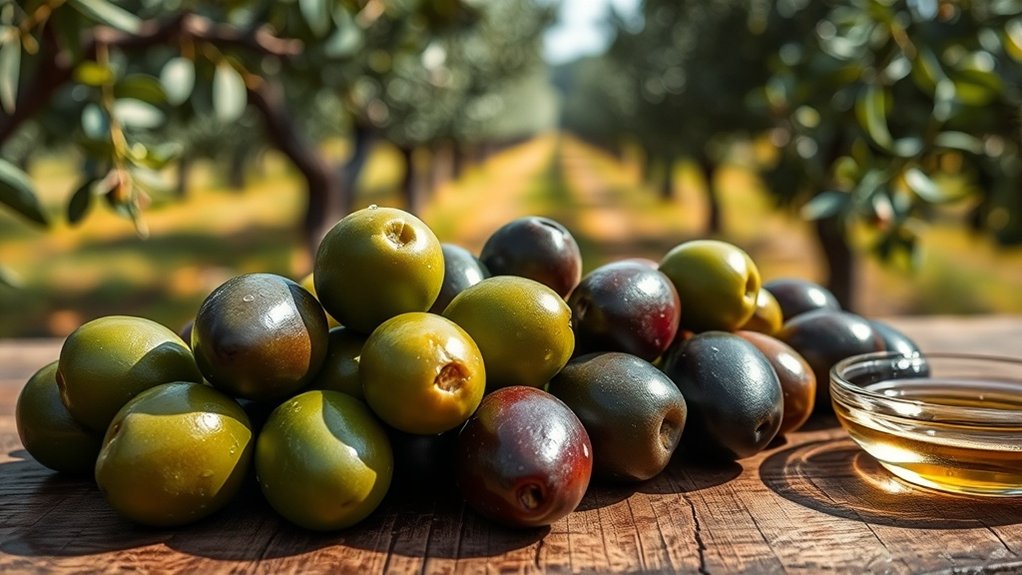
Beyond their developmental stages and harvest timing, olives exhibit an unusual biochemical composition that distinguishes them from conventional fruits: their lipid concentrations reach 15-30% of total mass, a stark deviation from the carbohydrate-dominant profiles you’ll observe in most drupes and pomes.
This adaptation serves xerophytic survival mechanisms:
- Energy storage optimization: Lipids provide 9 kcal/g versus carbohydrates’ 4 kcal/g, maximizing caloric reserves in water-limited environments.
- Desiccation resistance: Monounsaturated fatty acids maintain membrane fluidity under drought stress.
- Varietal differentiation: Cultivars like Picual demonstrate genetically determined oleic acid concentrations exceeding standard ranges.
The resulting triglyceride composition yields extra virgin olive oil‘s documented antioxidant polyphenols and anti-inflammatory compounds.
This lipid-centric metabolism fundamentally alters olives’ organoleptic properties, producing their characteristic umami-rich, savory flavor profile that you’ll recognize as distinctly non-sweet compared to typical fruits.
Olives share the defining architecture of stone fruits: an outer exocarp (skin), fleshy mesocarp, and lignified endocarp encasing a single seed. This structural classification places them firmly within the drupe category alongside peaches and cherries.
All three develop from a flower’s ovary through post-fertilization carpel development, making them true botanical fruits rather than vegetables.
You’ll notice olives’ mesocarp contains substantially higher lipid concentrations than typical drupes, though all three store energy in their flesh. During maturation, olives shift from green to purple-black, paralleling ripening patterns in other drupes.
Raw olives contain heightened tannin and polyphenol levels, rendering them unpalatable without curing—similar to how unripe peaches and cherries exhibit inedibility. This biochemical defense mechanism protects seeds until ideal dispersal conditions occur.
This article was reviewed by Nicole Anderson, RDN.