Last Updated: March 4, 2026
Is Worcester Sauce Vegan
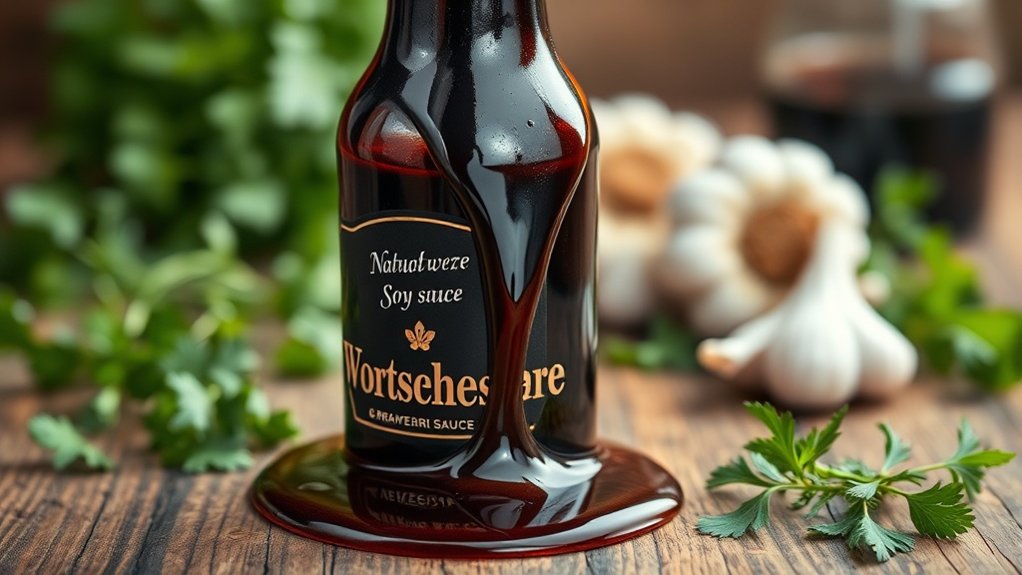
Traditional Worcestershire sauce isn’t vegan—it contains anchovies that provide essential umami compounds and savory depth. Lea & Perrins, the original 1837 formulation, explicitly lists anchovy extract as a core ingredient on its label. However, you’ll find several plant-based alternatives that replicate this complex flavor profile using ingredients like soy sauce, tamarind, apple cider vinegar, and molasses. Brands such as Whole Foods 365, Annie’s, and Wan Ja Shan offer vegan formulations available at major supermarkets and online retailers. Understanding ingredient hierarchies and certification labels will help you identify suitable alternatives for your culinary applications.
Contents
show
Why Traditional Worcestershire Sauce Contains Fish

Traditional Worcestershire sauce contains anchovies because these small saltwater fish provide the glutamate-rich umami compounds essential to the condiment’s characteristic savory depth.
When Lea and Perrins formulated the sauce in 1837, they incorporated anchovies specifically for flavor improvement, creating a complex taste profile that’s defined the condiment for nearly two centuries.
The fish sourcing process involves harvesting these marine creatures to extract their naturally occurring amino acids, which interact synergistically with the sauce’s vinegar and spice components.
You’ll find that anchovies remain a standard ingredient in most commercial Worcestershire sauces today, making label verification critical if you’re following a vegan diet.
The anchovy’s fermentation properties contribute irreplaceable depth that manufacturers have historically considered indispensable to authentic Worcestershire sauce production.
Best Vegan Worcestershire Sauce Brands to Buy
While mainstream Worcestershire sauce production relies on anchovy-derived umami compounds, several manufacturers have engineered plant-based formulations that deliver comparable glutamate profiles through alternative ingredients.
You’ll find Whole Foods Market 365 Organic Worcestershire Sauce offers economical ingredient sourcing while maintaining vegan standards through certified organic components.
Kroger’s formulation provides budget-conscious accessibility without compromising traditional vegan flavor profiles.
Wan Ja Shan Organic Worcestershire Sauce demonstrates advanced fermentation techniques, yielding umami-rich compounds with subtle sweetness through plant-based substrates.
The Wizard’s Sauces employs concentrated organic ingredients to amplify flavor intensity, creating bold taste profiles suitable for diverse culinary applications.
Each manufacturer’s approach to ingredient sourcing and fermentation methodology affects final vegan flavor profiles, though all successfully replicate the complex savory notes characteristic of traditional Worcestershire sauce through non-animal derivation pathways.
How to Make Vegan Worcestershire Sauce at Home

Creating vegan Worcestershire sauce requires combining apple cider vinegar, soy sauce or coconut aminos, and aromatic spices including garlic, onion, and allspice.
You’ll heat this mixture on low until it reaches a simmer, then allow it to cool to room temperature before transferring to storage.
The finished sauce maintains quality for 1-2 months when refrigerated, yielding approximately 1.5 cups per batch.
Essential Ingredients and Flavors
The fundamental composition of vegan Worcestershire sauce relies on three primary flavor components: acidity, umami, and aromatic complexity.
Apple cider vinegar provides the essential acidic foundation, while soy sauce or coconut aminos delivers the characteristic umami depth and saltiness. You’ll need molasses and tamarind paste to achieve the sauce’s signature savory richness through proper flavor pairings.
The aromatic profile requires allspice, garlic, and onion, which create multidimensional taste layers.
When employing appropriate cooking techniques, you’ll simmer these ingredients together, allowing molecular compounds to integrate and intensify.
For customization, maple syrup functions as a refined sugar alternative without compromising flavor balance.
This analytical approach to ingredient selection guarantees you’re replicating the traditional sauce’s complex taste profile while maintaining vegan compliance and achieving ideal shelf stability of 1-2 months when refrigerated.
Simple Preparation Steps
Making vegan Worcestershire sauce requires precise measurement and controlled heating to achieve ideal flavor integration.
You’ll combine apple cider vinegar, soy sauce, allspice, garlic, onion, mustard, and pepper in a pot, creating complex flavor profiles through ingredient synergy.
Heat the mixture on low until reaching a gentle simmer, which activates enzymatic reactions and releases volatile compounds. Remove from heat immediately to preserve delicate aromatics and prevent caramelization.
Once cooled to room temperature, transfer the sauce to a sterilized jar for refrigerated storage, where it maintains superior quality for 1-2 months.
This method yields approximately 1.5 cups of concentrate. For refined-sugar-free vegan alternatives, substitute maple syrup as your sweetening agent.
The resulting condiment delivers authentic umami characteristics while adhering to plant-based dietary requirements.
Storage and Shelf Life
After preparing your vegan Worcestershire sauce, proper storage protocols directly impact its chemical stability and microbiological safety. You’ll achieve ideal shelf stability by transferring the sauce into sterilized glass jars and refrigerating immediately at 4°C (39°F). The vinegar’s acidity and salt concentration create an inhospitable environment for pathogenic bacteria, allowing 1-2 months of flavor preservation when properly maintained.
Critical Storage Parameters:
- Store in airtight containers, shielded from light and heat sources to prevent oxidative degradation.
- Monitor for organoleptic changes (off-odors, discoloration, or surface film formation).
- Maintain consistent refrigeration temperatures below 4°C throughout the storage period.
- Label containers with preparation dates to track age and promote timely consumption.
The recipe’s 1.5-cup yield facilitates batch production while minimizing waste, allowing you to improve multiple dishes throughout the preservation window.
Does Vegan Worcestershire Sauce Taste Different?
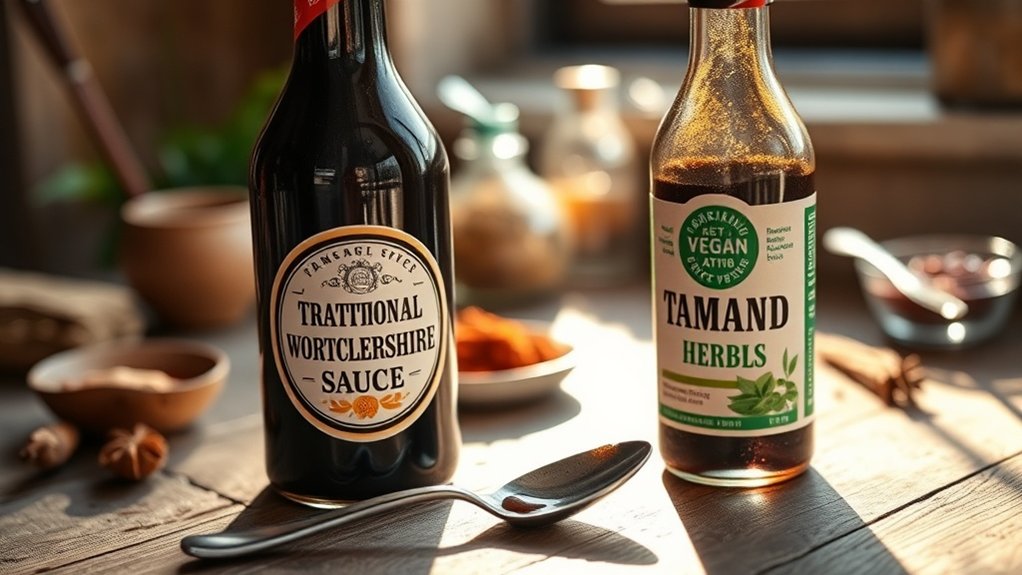
How does vegan Worcestershire sauce compare to its traditional counterpart in flavor profile? Vegan flavor profiles typically replicate the original’s complexity through strategic ingredient substitution. You’ll find apple cider vinegar, soy sauce, tamarind, and molasses forming the foundational taste architecture, replacing anchovies’ umami contribution.
Taste comparisons reveal nuanced differences: the fish-based glutamate depth transforms into plant-derived savory notes, though many users report minimal perceptual variance in prepared dishes.
Commercial brands demonstrate inconsistent formulations—Annie’s and Whole Foods’ 365 exhibit sweeter profiles compared to traditional versions. You can mitigate these variations through homemade preparation, adjusting spice concentrations and sweetener ratios to match your preferred flavor parameters.
The tamarind-molasses combination proves particularly effective in achieving comparable richness and tang, confirming functional equivalence in marinades, dressings, and cooked applications where the sauce integrates with other ingredients.
How to Read Labels for Hidden Non-Vegan Ingredients
Label scrutiny requires systematic examination of ingredient hierarchies, as manufacturers list components in descending weight order. When analyzing Worcestershire sauce labels, you’ll need to identify hidden ingredients that compromise vegan status.
Label clarity varies greatly between brands, making systematic evaluation essential.
Critical indicators requiring verification include:
- Anchovies, fish sauce, or anchovy paste – primary animal-derived components in traditional formulations
- “Natural flavoring” – ambiguous terminology potentially masking non-vegan additives requiring manufacturer clarification
- Gelatin or Worcestershire powder – animal-derived ingredients frequently overlooked during casual inspection
- Vegan certifications – explicit “plant-based” or “vegan” designations confirming ingredient compliance
Examine alternative ingredients like tamarind, molasses, and vinegar in plant-based versions.
Cross-reference ingredient lists with manufacturer documentation when ambiguous terminology appears, making certain thorough identification of animal-derived components.
Soy-Free and Gluten-Free Vegan Worcestershire Options
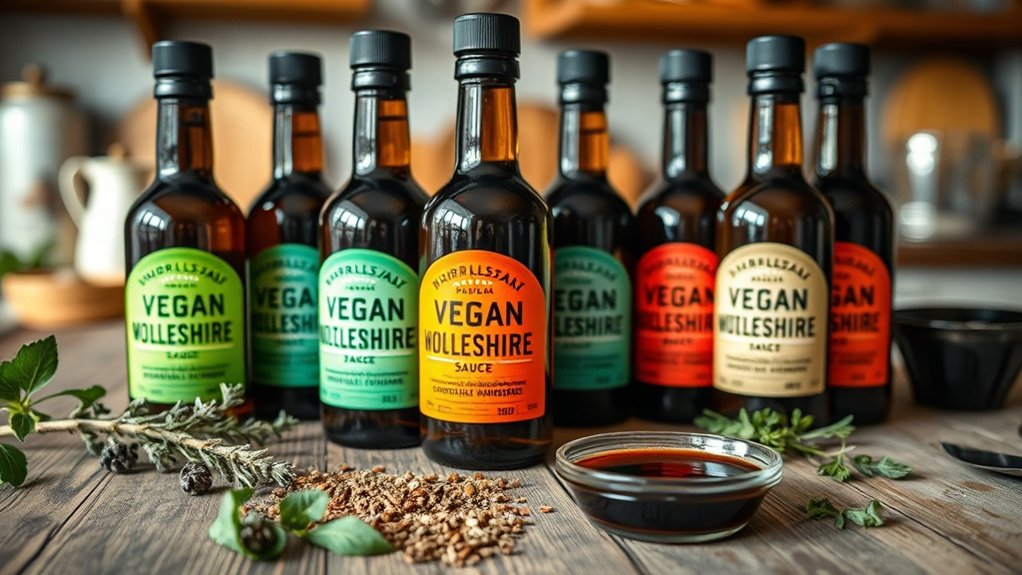
If you’re managing soy or gluten sensitivities, you’ll find that coconut aminos serve as an effective umami-rich substitute in vegan Worcestershire formulations, delivering comparable flavor compounds without allergenic proteins.
For gluten-free requirements specifically, tamari—a naturally brewed soy product minus wheat—provides the necessary amino acid profile while maintaining GFCO certification standards.
Commercial manufacturers like Annie’s and Wan Ja Shan have developed allergy-friendly formulations that meet both soy-free and gluten-free specifications through precise ingredient substitution matrices.
Coconut Aminos as Substitute
For individuals with soy or gluten sensitivities, coconut aminos represents the most viable Worcestershire sauce alternative due to its inherently allergen-free composition.
Derived from fermented coconut blossom sap and sea salt, this substitute delivers comparable umami depth while maintaining a slightly sweet flavor profile. Although it lacks traditional Worcestershire’s vinegar-based tanginess, you can fortify it with added vinegar to achieve greater complexity.
Key advantages of coconut aminos:
- Contains considerably lower sodium levels than conventional soy sauce, supporting cardiovascular health
- Provides versatile application across marinades, dressings, and savory preparations
- Delivers authentic umami depth without introducing coconut flavor into dishes
- Maintains shelf stability and consistent performance in both raw and cooked applications
This alternative enables you to replicate traditional Worcestershire applications while accommodating dietary restrictions effectively.
Tamari for Gluten-Free Versions
Tamari provides gluten-intolerant individuals with a superior base ingredient for crafting vegan Worcestershire sauce, as this Japanese fermentation product undergoes processing without wheat additives present in standard soy sauce formulations.
This characteristic positions tamari among preferred gluten free alternatives for recipe modification. You’ll achieve umami improvement through tamari’s concentrated amino acid profile, which delivers richer, less sodium-dominant flavors compared to conventional soy sauce.
Substitution ratios remain 1:1, maintaining recipe integrity without flavor compromise. However, vigilant label verification proves essential—manufacturing processes vary across brands, with some products containing gluten contaminants or non-vegan additives despite tamari classification.
Commercial vegan Worcestershire formulations increasingly incorporate tamari as their foundational component, addressing dual dietary requirements: plant-based consumption and gluten sensitivity.
This ingredient selection demonstrates how traditional sauce profiles adapt to accommodate modern dietary restrictions without sacrificing flavor complexity.
Commercial Allergy-Friendly Brands
When evaluating commercial alternatives, you’ll find these products demonstrate sophisticated flavor comparisons:
- Wan Ja Shan Organic Worcestershire Sauce provides rich, naturally-derived taste complexity without soy or gluten contamination.
- Annie’s Organic Vegan Worcestershire Sauce eliminates fish derivatives and artificial additives while preserving robust flavor intensity.
- Coconut-based formulations offer enzymatic fermentation benefits that mimic traditional brewing processes.
- Date and tamarind combinations create authentic tangy-sweet profiles matching conventional Worcestershire characteristics.
Using Vegan Worcestershire Sauce in Classic Recipes
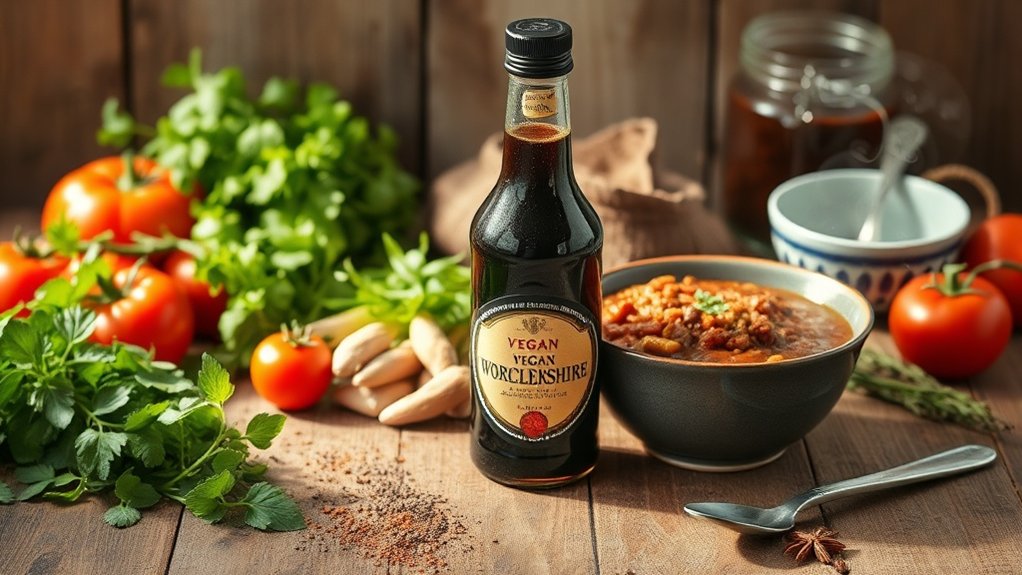
Since traditional Worcestershire sauce contains anchovies as a fundamental ingredient, vegan alternatives have become vital for plant-based adaptations of classic recipes.
You’ll find that vegan Worcestershire effectively replicates umami-rich vegan flavor profiles in preparations like Vegan Wellington, Swedish meatballs, and marinades. The substitution maintains flavor integrity through ingredient combinations of apple cider vinegar, soy sauce, and spices—yielding approximately 1.5 cups when prepared homemade.
Commercial options from Annie’s and Whole Foods’ 365 provide anchovies-free formulations without artificial additives, suitable for immediate use.
Classic dish adaptations benefit greatly when you incorporate vegan Worcestershire into gravies and lentil preparations, where it improves depth without compromising plant-based dietary requirements.
The one-to-one ratio substitution guarantees consistent results across traditional recipes requiring Worcestershire sauce’s distinctive savory character.
Where to Find Vegan Worcestershire Sauce in Stores
Having established vegan Worcestershire‘s culinary applications, you’ll need to locate reliable retail sources for procurement. Major supermarket chains like Kroger and Whole Foods stock fish-free formulations from Annie’s and 365 Organic brands. These mainstream options provide consistent vegan flavor profiles suitable for recipe standardization.
Strategic sourcing locations include:
- Specialty retailers and online platforms carrying Wan Ja Shan and Urban Platter brands
- Local stores featuring artisanal or house-made variations with distinctive taste characteristics
- Natural food sections within conventional supermarkets
- International food markets offering region-specific vegan formulations
When selecting products, verify “vegan” certification labels to confirm complete animal-ingredient elimination.
Specialty retailers typically maintain broader inventories, enabling comparative analysis of alternative uses across different brands. This expanded selection facilitates matching specific flavor compounds to intended culinary applications, whether for marinades, cocktails, or sauce preparation.
Can You Substitute Soy Sauce or Tamari Instead?
You can substitute soy sauce or tamari for Worcestershire sauce, though these alternatives won’t replicate the complete flavor profile.
Soy sauce provides comparable umami and salinity but lacks the tangy acidity and spice complexity inherent to traditional Worcestershire formulations.
Tamari functions as a gluten-free option with similar savory characteristics, yet you’ll need to adjust quantities and compensate for missing acidic components by incorporating vinegar or citrus juice.
Soy Sauce Flavor Differences
While soy sauce and tamari can technically substitute for Worcestershire sauce in recipes, they won’t deliver an identical flavor profile. Understanding these taste variations helps you make effective recipe adaptations.
Soy sauce brings pronounced umami richness and saltiness, but lacks Worcestershire’s distinctive tangy-sweet complexity. Ingredient comparisons reveal fundamental differences in their culinary uses.
Key distinctions in flavor profile:
- Soy sauce delivers intense saltiness with straightforward umami depth, while Worcestershire balances acidity, sweetness, and spice complexity.
- Tamari offers smoother, less aggressive umami richness compared to traditional soy sauce.
- Worcestershire sauce provides unique tangy notes that soy-based alternatives can’t replicate.
- Quantity adjustments are essential when substituting to prevent overwhelming saltiness in your dishes.
For best results, consider reducing the amount when using soy sauce or tamari as Worcestershire replacements.
Tamari as Gluten-Free Option
Because traditional soy sauce contains wheat as a primary ingredient, tamari emerges as the superior gluten-free alternative for vegan Worcestershire sauce formulations.
You’ll find that tamari’s production process relies mainly on fermented soybeans, eliminating gluten concerns while preserving essential umami characteristics.
The tamari benefits extend beyond allergen avoidance—you can implement a straightforward 1:1 substitution ratio when replacing soy sauce in homemade recipes, maintaining consistent saltiness and flavor depth.
When evaluating tamari varieties, prioritize certified organic and non-GMO options to guarantee ingredient integrity in your vegan preparations.
This substitution improves flavor complexity through fermentation-derived compounds while simultaneously addressing both gluten sensitivities and plant-based dietary requirements.
The result is a Worcestershire sauce alternative that meets multiple dietary specifications without compromising taste profiles.
Adjusting Quantities and Taste
When substituting soy sauce or tamari for Worcestershire sauce, you’ll need to account for fundamental compositional differences that affect flavor architecture. Both alternatives deliver umami and salinity but lack inherent acidity, requiring deliberate ingredient balancing to replicate Worcestershire’s complexity.
Essential flavor adjustments:
- Start with reduced quantities—use approximately 75% of the specified Worcestershire amount initially.
- Add apple cider vinegar (1:4 ratio vinegar to soy sauce) to restore missing acidic notes.
- Taste iteratively throughout cooking, as sodium concentration varies between brands.
- Consider coconut aminos for soy-free applications, though flavor complexity will differ.
The brewing processes for soy sauce and tamari create distinct taste profiles from traditional Worcestershire fermentation.
You’ll achieve excellent results by treating substitution as a multi-component replacement rather than direct exchange, adjusting proportionally based on your dish’s specific requirements.
Is Lea & Perrins Worcestershire Sauce Vegan?
Lea & Perrins Worcestershire sauce isn’t vegan due to its anchovies content, which serves as a fundamental component in the original 1837 formula. The Worcestershire sauce history reveals that fish derivatives have remained integral to this brand’s authentic recipe for nearly two centuries.
You’ll find anchovies explicitly listed in the ingredients panel, yet many consumers overlook this non-vegan component.
When examining product labels, you must verify the presence of fish-derived ingredients before purchasing. The market now offers several anchovy alternatives that successfully replicate the umami-rich profile characteristic of traditional Worcestershire sauce.
These vegan formulations use plant-based ingredients like soy sauce, tamarind, and fermented vegetables to achieve comparable flavor complexity. If you’re maintaining a strict plant-based diet, selecting certified vegan Worcestershire sauces guarantees complete adherence to your dietary requirements.
This article was reviewed by Nicole Anderson, RDN.