Last Updated: December 3, 2025
Are Jellybeans Vegan
Most jellybeans aren’t vegan because they contain animal-derived ingredients you mightn’t expect. Popular brands use gelatin (from animal collagen) for chewiness, shellac (from lac beetle resin) for shine, and beeswax as a coating agent. Even seemingly plant-based components like certain red dyes contain carmine from crushed insects. However, you’ll find vegan-compliant options from brands like Jolly Ranchers, YumEarth, and Warheads that rely exclusively on plant-based gelling agents like agar-agar. Understanding specific ingredient compositions helps you identify which brands align with your dietary requirements.
Contents
show
Understanding Why Most Jellybeans Are Not Vegan-Friendly
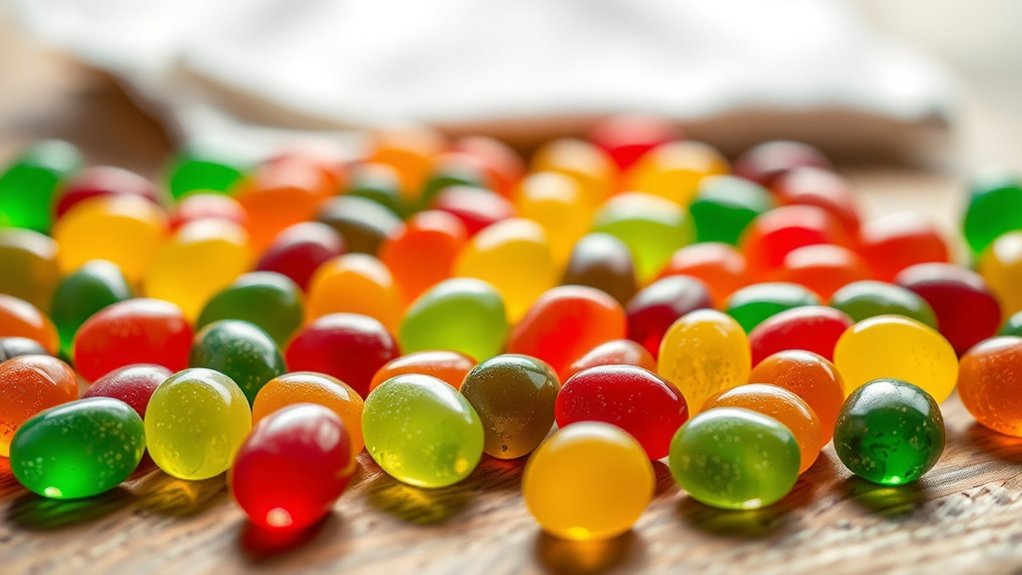
While jellybeans appear deceptively simple as colorful sugar candies, their ingredient composition reveals multiple animal-derived components that disqualify most commercial varieties from vegan classification.
When you’re asking “are jelly beans vegan,” you’ll find the answer is typically no due to several key ingredients.
Shellac, a resin secreted by female lac bugs, provides the characteristic glossy coating. Gelatin, extracted from animal collagen, creates the chewy texture in many brands. Beeswax serves as another common glazing agent.
Even seemingly plant-based ingredients warrant scrutiny—sugar processing often involves bone char filtration, and “natural flavors” may originate from animal sources.
These multiple animal-derived components mean you’ll need to carefully examine ingredient labels before determining whether specific jellybean products align with vegan dietary principles.
Breaking Down Non-Vegan Ingredients in Jellybeans: Gelatin, Shellac, Beeswax, and Carmine
Gelatin stands as the most prevalent animal-derived ingredient in jellybeans, manufactured through prolonged hydrolysis of collagen extracted from cattle bones, pig skin, and connective tissues.
This protein-based gelling agent provides the characteristic chewy texture you’ve come to expect.
Shellac, alternatively labeled as confectioners glaze, functions as a surface coating derived from lac beetle resin secretions.
It creates the distinctive glossy appearance while preventing moisture loss.
Beeswax serves as another coating agent, though you’ll find it less frequently.
Most vegans reject this ingredient due to ethical concerns surrounding commercial bee farming practices.
Carmine presents as a vibrant red pigment produced by crushing cochineal insects.
Manufacturers incorporate it to achieve specific color profiles, particularly in red and pink varieties.
You’ll need to scrutinize ingredient labels carefully to identify these animal-derived components.
Brand-by-Brand Vegan Status: Jelly Belly, Brach’s, Starburst, and More
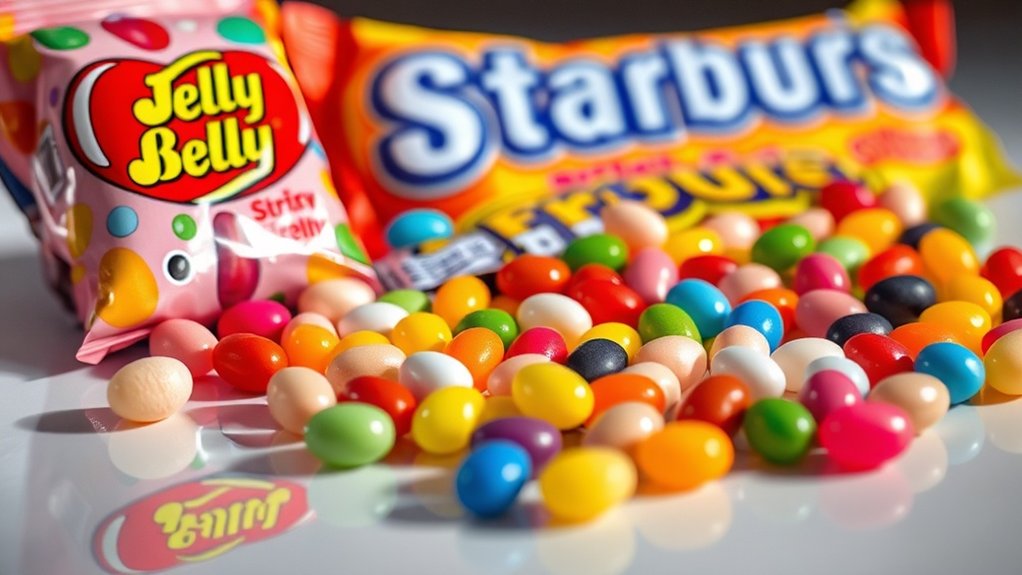
Maneuvering the jellybean market requires examining each manufacturer’s formulation, as ingredient compositions vary greatly across brands.
Jelly Belly incorporates beeswax and shellac—both animal-derived compounds—rendering their products non-vegan. Brach’s formulations typically contain gelatin, a collagen-based protein extracted from animal connective tissues, disqualifying them from vegan consideration.
Starburst jelly beans likewise use gelatin as a binding agent, despite their fruit-forward flavor profiles.
However, you’ll find vegan-compliant options in Jolly Ranchers Jelly Beans, which exclude all animal-derived ingredients from their composition. YumEarth Naturals Sour Jelly Beans represent another plant-based alternative, formulated without gelatin, beeswax, or shellac while maintaining natural ingredient standards.
When selecting jellybeans, you must scrutinize ingredient labels carefully, as manufacturing processes and formulations differ greatly between brands, affecting their suitability for vegan diets.
Certified Vegan Jellybean Brands and Where to Find Them
Upon examining certified vegan jellybean formulations, you’ll identify five brands that meet strict plant-based standards: Jolly Ranchers, Warheads, Wonka Nerds, YumEarth, and VeganSweets.
Jolly Ranchers Jelly Beans deliver original fruity flavors through exclusively plant-derived ingredients. Warheads Sour Jelly Beans provide tangy profiles without gelatin or animal products.
YumEarth Naturals incorporates real fruit juice and Vitamin C, eliminating harmful additives while maintaining vegan compliance. VeganSweets specifically formulates products excluding gelatin, beeswax, and shellac—three common non-vegan ingredients in conventional jellybeans.
You’ll find these brands at natural food retailers, specialty vegan stores, and major online marketplaces. YumEarth and VeganSweets appear frequently in health-focused grocery chains, while Jolly Ranchers and Warheads stock conventional supermarket candy aisles.
Direct manufacturer websites offer additional purchasing options with detailed ingredient transparency.
How Jellybean Coatings and Production Methods Affect Vegan Status
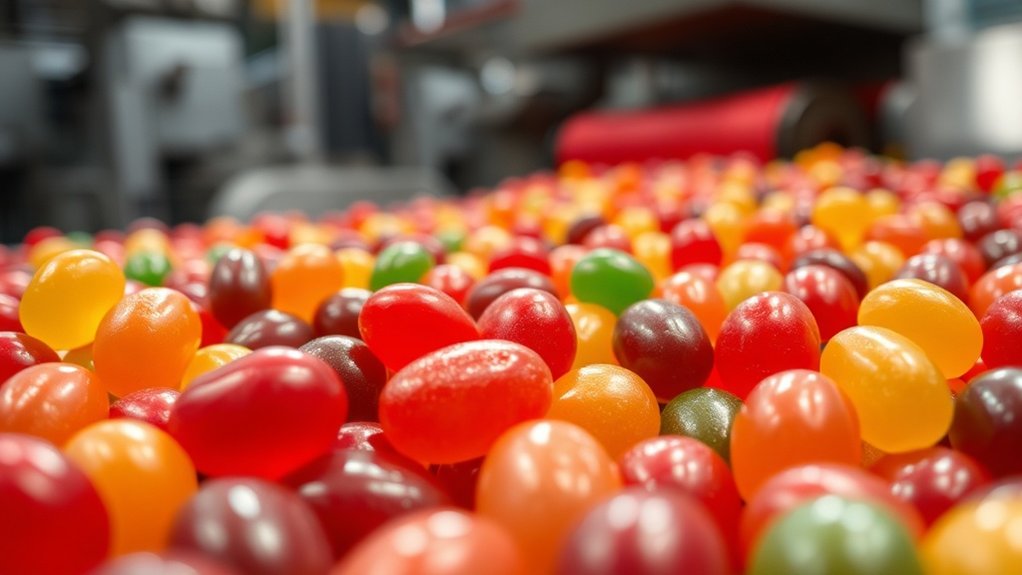
While brand selection provides your initial vegan screening, jellybean surface treatments introduce additional animal-derived components that compromise plant-based compliance.
Shellac, a resin secreted by female lac bugs, creates the characteristic glossy coating on most jellybeans. The extraction process involves collecting bug secretions, frequently resulting in insect mortality, making it fundamentally non-vegan.
Beeswax represents another common coating agent that vegans reject due to animal exploitation concerns.
Beyond surface treatments, production methods warrant scrutiny. Gelatin, derived from animal collagen, appears in certain formulations as a binding agent, though some manufacturers have eliminated it.
Ingredient transparency varies considerably across brands, necessitating careful label examination. You’ll need to specifically identify shellac, beeswax, and gelatin listings to accurately determine vegan compatibility before purchasing.
Making Your Own Vegan Jellybeans at Home: Recipes and Techniques
Creating vegan jellybeans at home requires agar-agar as your primary gelling agent, a seaweed-derived polysaccharide that replicates gelatin’s textural properties without animal extraction.
You’ll combine fruit juice, sugar, and corn syrup in a saucepan, heating until complete dissolution occurs. Then integrate agar-agar and transfer the mixture into silicone molds for setting.
For chromatic variation, you can use plant-based colorants: beet juice produces red hues, turmeric yields yellow tones, and spirulina generates green pigmentation.
The mixture requires several hours of cooling to achieve ideal structural integrity. After extraction from molds, coat your jellybeans with cornstarch to prevent adhesion between pieces.
You’re able to customize both flavor profiles and morphological characteristics by selecting different fruit juices and mold configurations, enabling experimental confectionery development within plant-based parameters.
This article was reviewed by Nicole Anderson, RDN.